
Turn and See
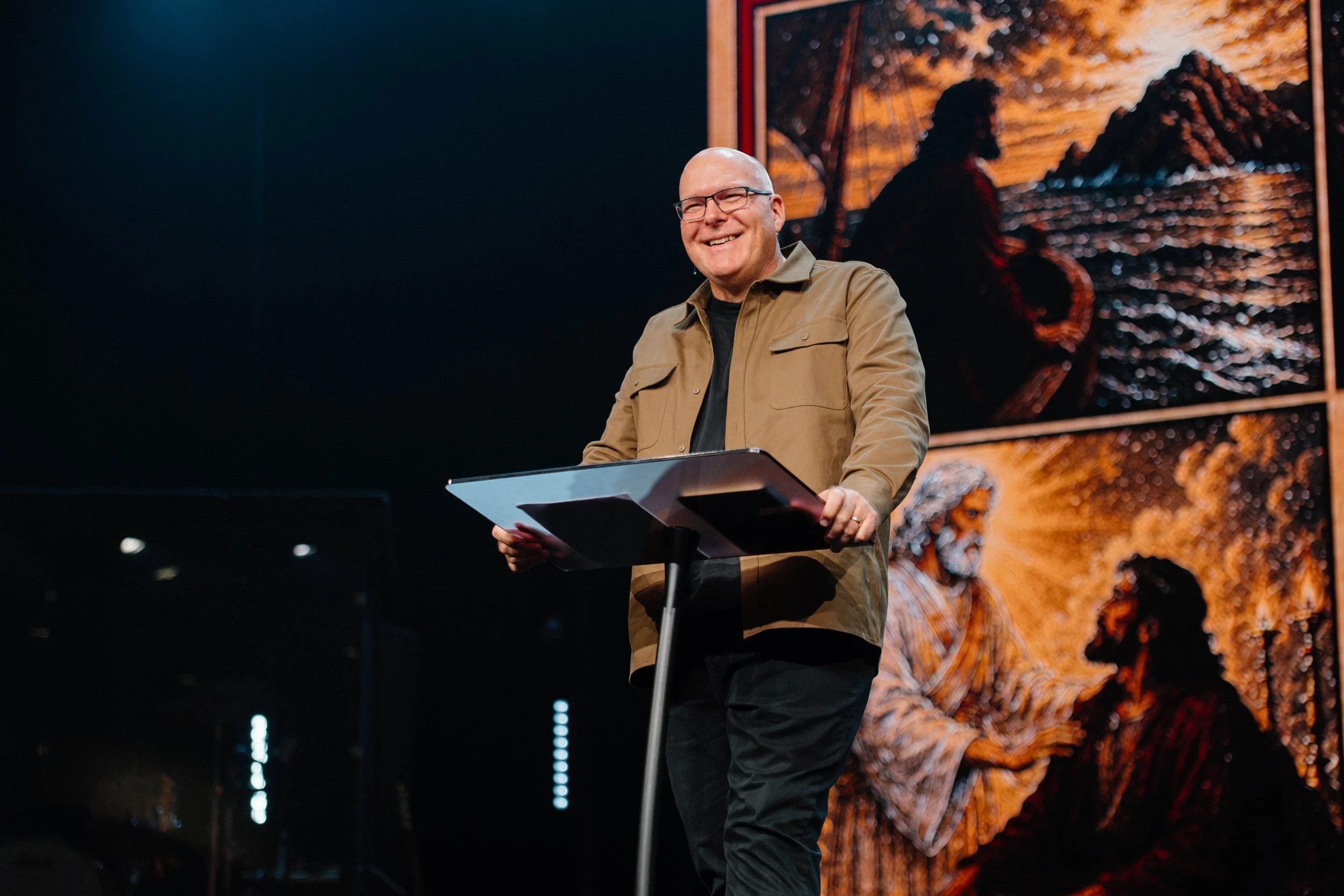
Pastor Sonny Misar
September 6, 2026 Message Recap
John was ninety years old, exiled to a rock quarry on a small island, when a voice like a trumpet spoke from behind him.
God never intended our knowledge of Him to arrive all at once. A relationship with Christ was always meant to be dynamic, ever-expanding, and capable of surprising us decades into walking with Him. John had known Jesus longer than almost anyone alive—sixty years of friendship, memory, and ministry, and there was still more of Him to see.
But it can be easy to settle for the version of Jesus we met once and stop expecting anything new. We get familiar with our own history with Him, and familiarity can quietly calcify into assumption. We stop looking at Jesus in new ways because we think we have already seen everything worth seeing.
On Patmos, all John could see most days was a quarry full of rocks, forced labor, isolation, and the slow erosion of everything his life used to look like.
Then he turned.
Those three words changed everything for John. He heard the voice of God, and instead of staying fixed on the rocks in front of him, he turned around, and what he saw undid him completely. John, the same man who once called down fire on a village, fell at his feet like a dead man. He saw Jesus, hair like white wool, eyes like fire, a voice like the roar of many waters, and a face shining like the sun in full strength.
We all have our own version of that rock quarry, like John was exiled to. A health crisis, a broken relationship, a disappointment with people, with ourselves, or even with God, something that keeps our eyes fixed forward on the one thing we cannot fix. It is exactly there that Jesus tends to sneak up behind us, closer than we assumed, waiting for us to turn.
Turning is not a one-time event. It is how we keep growing, how old paradigms get shattered, and God shows us a wider view of what He is doing. It costs something: you cannot turn toward a new dimension of Jesus without turning away from whatever has been holding your attention instead.
What pile of rocks have you been staring at, and what might you see if you finally turned around?
Scripture References:
Tap to watch the sermon!
About Radiant Church
Founded in 1996, Radiant Church has grown into a multi-location church committed to biblical teaching, discipleship, and mission.
At Radiant Church, there is an invitation to grow in your spiritual journey, build meaningful community, and truly get connected. We are passionate about helping people grow in faith, encounter the Presence of God, and become part of a church grounded in Spirit and truth.
Here's a 5-day devotional guide based on this sermon:
Day 1: Zeal in the Wrong Direction
Acts 9:1–2 | Philippians 3:4–6
Saul was not indifferent to God, he was consumed by what he believed was faithfulness, hunting down believers with letters of authority in hand. His credentials were impressive: trained under a top rabbi, blameless under the law, zealous to the point of violence. Religious zeal is not proof you are headed the right direction. It is possible to be sincerely convinced and still be sincerely wrong.
Day 2: Interrupted by Light
Acts 9:3–6 | John 1:4–5
A light from heaven stopped Saul mid-journey, and a voice spoke his name twice, the way Scripture often signals a moment of direct, personal address. Saul did not go looking for this encounter. It found him, mid-stride, mid-mission, mid-certainty. John describes Jesus as the light that darkness could not overcome, and Saul is proof that no amount of religious momentum can outrun it either.
Day 3: Three Days in the Dark
Acts 9:8–9 | Psalm 139:11–12
Saul spent three days blind, unable to eat or drink, before Ananias ever arrived. That darkness was not punishment, it was space to finally see the truth about himself. David wrote that even darkness is not dark to God, that it becomes as light around Him. Sometimes the most disorienting seasons of your life are exactly where God is doing the deepest work.
Day 4: Everything Counted as Loss
Philippians 3:7–9 | Matthew 13:44–46
Paul later described his old credentials, his pedigree, his righteousness under the law, as rubbish compared to knowing Christ. That is not self-hatred, it is recalibrated value. Jesus described the kingdom as treasure worth selling everything to obtain, and Paul lived out exactly that trade. What you count as gain reveals what you actually believe is valuable.
Day 5: Grace for the Chief of Sinners
1 Timothy 1:13–16 | Ephesians 2:8–9
Years later, Paul called himself the chief of sinners, not because his sin was uniquely worse than everyone else's, but because he had seen with unusual clarity how much mercy it took to save him. Paul insists salvation is a gift, not a result of works, so that no one has room to boast. The same grace that stopped Saul on the road to Damascus is the same grace available to you today, no matter how far gone you think you are.